
We install and service well pumps, septic tank pumps, booster pumps, and many other types of water pumps. We specialize in troubleshooting and diagnosing pump systems of all sizes.
Van Franey Plumbing can install & service all types of water & well pumps including:
- Deep Well Jet Pumps
- Shallow Well Jet Pumps
- Stainless Steel Submersible Well Pumps
- Cast Iron Shallow Well Jet Pumps
- Convertible Jet Well Pump
- Thermoplastic Shallow Well Jet Pumps
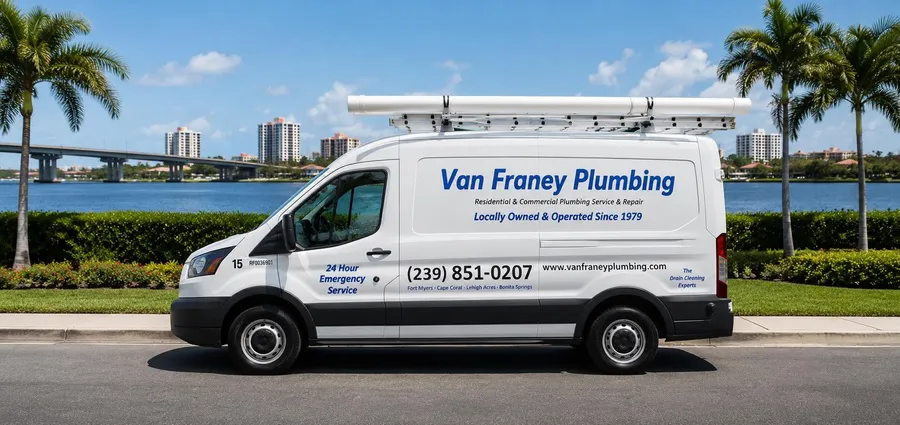

Private wells in Lehigh Acres, Alva and Buckingham
A large share of eastern Lee County is not on a utility. Most of Lehigh Acres, nearly all of Alva and Buckingham, and the acreage east of Estero draw water from private wells, and a good many of those homes are on septic as well. When the water stops in one of those houses there is no utility to call. The pump, the pressure tank, the switch and the wiring are the homeowner's, and the plumber who works on them needs to know well systems, not just house plumbing.
We service every kind of residential well system found in this part of the county. That includes the older shallow jet pumps on a sand point, the deeper wells that reach the sandstone layer and need a submersible, and the pumps that feed a house and an irrigation zone off the same well.
Pumps, pressure tanks and switches
A well system has three parts that fail, and they fail in different ways. The pump moves the water, whether it is a jet pump in the garage or a submersible down the casing. The pressure tank holds a cushion of air so the pump does not run every time a faucet opens. The pressure switch turns the pump on and off between its cut-in and cut-out settings.
Short cycling, where the pump kicks on and off every few seconds, is nearly always a waterlogged tank that has lost its air charge or a failed bladder. A pump that runs and never shuts off has lost its prime, has a leak in the drop pipe or foot valve, or is drawing from a well that has fallen below the intake in the dry season. Burnt contacts on the pressure switch cause a pump that works one day and not the next. We check the whole system, not just the part that looks bad, because a new pump on a waterlogged tank will wear out the same way the old one did.
No water at all: finding the cause
When the taps go dry, there is a short list to run through before anyone pulls a pump. Is there power at the breaker and at the pressure switch? Is the pressure gauge reading zero, or is it holding pressure with nothing coming out, which points to a valve or a frozen switch rather than the well? Does the pump hum with no flow, which suggests a seized motor or a lost prime? Is the well casing itself dry, which happens in April and May at the end of a dry winter?
On the visit we test the switch and the capacitor, measure the tank charge, and check the pump draw with a meter before deciding anything. If the pump has to come out of the well, we tell you what we found down the hole and what the replacement involves before the work starts. A submersible replacement is usually done in one visit when the well depth and pipe size are known. A pump that runs and never shuts off can burn itself out overnight, so turn the breaker off if you cannot stop it any other way, and call. A plumber answers 24/7.
Well water quality and treatment
Well water in this county is hard, and much of it carries iron, a sulfur smell, and sometimes tannins from the surrounding wetland. Iron stains fixtures orange, sulfur smells like rotten eggs at the hot tap first, and hardness scales the water heater and the well pump itself. None of that means the well is bad. It means the water needs treatment matched to what is actually in it.
We start with a test. A basic well test looks at hardness, iron, pH, sulfur and bacteria; the results tell us whether the house needs a softener, an iron filter, an aeration or oxidizing unit, or a combination. Treatment sized to the test lasts. Treatment bought off the shelf for a problem the water does not have is money spent for nothing. We install and service the system, and we set the pump and tank so the treatment equipment gets the flow and pressure it needs.
After a storm: disinfecting a well
Hurricanes and the flooding that follows them are the hardest thing a well goes through. A wellhead that went under standing water should be treated as contaminated until it is tested. Power outages leave the tank drained and the pump stopped, and a pump that was running when the power cut can lose its prime.
When the power returns, check the well cap and casing for damage, run an outside spigot until the water clears, and do not drink from the tap until the well has been shock chlorinated and a bacteria test comes back clean. We disinfect wells, replace flooded pumps and controls, and restart systems after the storm season, and we can put a test kit in your hands so you know when the water is safe again.
- Wellhead under floodwater: treat the well as contaminated, test before drinking.
- Pump stopped after an outage: check the breaker and switch, then reprime if needed.
- Cloudy or brown water after the storm: run an outside tap until clear, then test.
- Sulfur smell or iron staining that is new: the water has changed, retest and adjust treatment.
Call Van Franey Plumbing at (239) 851-0207 to install, repair or service your water or well pump
Learn more before you call
- No water at all? Meter, well pump, or utility
- Well water testing checklist for Lehigh Acres, Alva, and rural Lee County homes
- Lehigh Acres water: wells, utility water, and what to treat
- City water vs well water: two different treatment problems
- Hurricane plumbing checklist for Southwest Florida: before, during, and after the storm
Common questions about well pumps
Why does my well pump turn on and off every few seconds?
That is short cycling, and it almost always means the pressure tank has lost its air charge or the bladder inside has failed. Running the pump that way wears out the motor and the switch, so it is worth fixing soon.
How long does a well pump last?
Submersible pumps commonly run ten to fifteen years; jet pumps often less, especially where iron and sand are heavy. A pump that short cycles or runs dry will fail sooner. We check the tank and switch with every pump replacement so the new one gets its full life.
Do you service the well itself, or only the pump?
We service the pump, the drop pipe, the foot valve, the pressure tank, the switch and the controls, and we disinfect wells. Drilling a new well or deepening a casing is a well driller's job, and we can tell you when that is the answer.
Can you treat iron and sulfur in well water?
Yes. We test the water first, then match the treatment to the result: an iron filter, a softener, an aeration or oxidizing unit, or a combination. We install and service the equipment and set the pump system to feed it correctly.